Showing posts with label test corrections. Show all posts

Monday, October 18, 2010

Correction for number 7


Question:
From the origin,where would you move to plot the ordered pair (4,0)?
a)up 4 units c)left 4 units
b)right 4 units d)down 4 units

Answer:
The answer is: B right 4 units


I hope this things help you!

Correction for number 11

Completion
Complete each statement.


Question: A line of reflection is also called a (n)

Answer: Mirror line.


Corrections to number 2

Indicate whether the statement is true or false.


Translations, rotations , and reflections change the size of the sides or angles of the orginal figure.
Answer: False
Explanation: Because you are only moving the original figure, by sliding it reflecting it or rotating it, but the figure stays the same.
Pictures of Translation , Reflection , and Rotation.


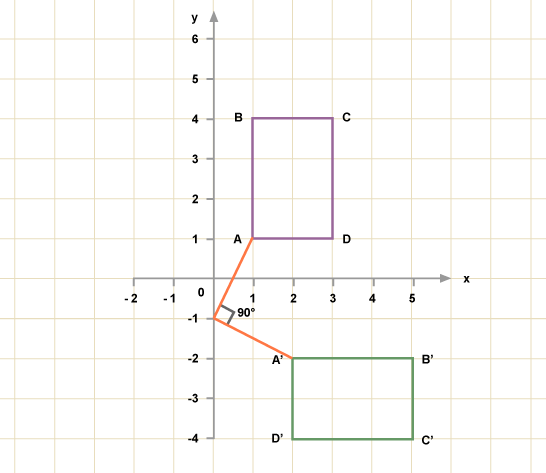
Corrections for number 10


In which quadrant is the point with coordinates (11,-6) ?

a.II c.III
b.II d.IV

Answer: d.IV (quadrant IV)

Correction for Number 10

A coordinate grid is divided into four sections. Quadrant 1 is (+,+), quadrant 2 is (-,+), quadrant 3 is (-,-) and quadrant 4 is (+,-). For example the coordinates (-2, 3) would be in quadrant 2 because (-,+).

The question was in which quadrant is the point with coordinates (11,-6)?

The answer is quadrant 4 because (+,-).


Here is a link to help you plot points
http://www.mathplayground.com/locate_aliens.html


Here is a video to help you understand more.


I hope all this information helps you understand more!

Correction for Number 12


The fixed point about which a rotation occurs is called the________.


Answer: centre of rotation


Here's an example of centre of rotation.


Try this link. This game will help you plotting coordinates. It is so fun!:

Test corrections for number 2

Translation, rotations, and reflections change the size of the sides or angles of the original figure. True or false? ... False Any transformation doesn't change the original shape for example:

even though you made a transformation the figure stays the same.

Correction for Number 15

A(n) translation arrow shows distance and direction a figure has moved on a coordinate grid.


This is a example image of a Translation Arrow.


>

p>


You can also try this link to learn more about coordinates.

This is a video of how to translate a shape.


I hope it helps you.


Math corrections for number 9

___9. Which point on the coordinate grid has he coordinates (-1,2)

a. A
b. B

c. C
d. D


It is letter b because it says (-1,2) right so you go 1 unit left from the origin on the x-axis. Then go up 2 units on the y-axis. It ends up in quadrant II.

Do this to help you learn about plotting points :D

Here is a video that might help you also it starts off with a number line that is half of the Cartesian plane then it will go to the coordinate grid and teach you about plotting points.


I hope this helps you (:

Correction on number 21

Describe letter a. type of transformation needed:

A.) turning a knob to a open door


The answer is Rotation.

The answer is because if you try to do it in real life, you will notice that the door knob will turn either counterclockwise or clockwise same as the rotation. The rotation will depend on the degrees it will rotate. It either rotate on 90, 180, 360 and etc.


Corrections for Number 5

A coordinate grid has the following set of ordered pairs: (-2,-5), (0,-4), (3,0), (4,1), (5,2), (6,3). The point (0,-4) is out of place. True or False?

True. All the ordered pairs are plotted straightly except for point (0,-4).

Here is a picture of a coordinate grid to help you.


This link will take you to a fun math site where you can practice plotting an ordered pair.
http://www.funbrain.com/co/index.html


Video of plotting an ordered pair.


I hope it helps you!


Correction for number 10

Question: In which quadrant is the point with coordinates (11, -6)?
a.I
b.II
c.III
d.IV

Solution: Look at this coordinate grid:


-If you can see there is a line going up (Vertical) and going side (Horizontal).They are also called Y axis and X axis. Y axis is the line that goes up and it is always in the last when you write the coordinate of a point.
-While the side line (Vertical) or X Axis is the line that goes sideways and it is always in the first when you write the coordinate grid of a point.


-When plotting a points in a coordinate grid, always look for the number in the X axis, Vertical, Side line first and finally you should look again for the number that you're looking for in the Y axis, Horizontal, Up line.
-A coordinate grid is compose of 4 parts (Quadrant I, II, III, IV)
-In the middle of a coordinate grid there is a 0 there. 0 is either Positive or negative,It is also calles the origin


-So if we plot (11, -6) in a coordinate grid.Which Quadrant the point will plot?


Here's the answer: