Answer: The height of the stripe can be 6 m. I got it by dividing 9 m to 1.5 m which the answer is 6 m.
11.A.)Question: With a ruler, measure the base and height of this parallelogram. Explain how you measured.
Answer: b= 1.5 cm , h= 2 cm. I measured the base by measuring the bottom part of the parallelogram which I got 1.5 cm. I measured the height by measuring the top to the bottom of the parallelogram which I got 2 cm.
B.)Question: What is the area?
Answer: The area of the parallelogram is 3 cm. How I got it is by multiplying b= 1.5 cm to h= 2 cm.
C.)Question: Use a different side of the parallelogram as the base. Determine the new height and calculate the area. How does this compare to your answer in b)?
Answer: I used the base as the height for B.) which I got 2 cm. I used the height as the base for B.) which I got 1.5 cm. Basically, I just change the position of the numbers which means that the parallelogram have 4 equal sides.
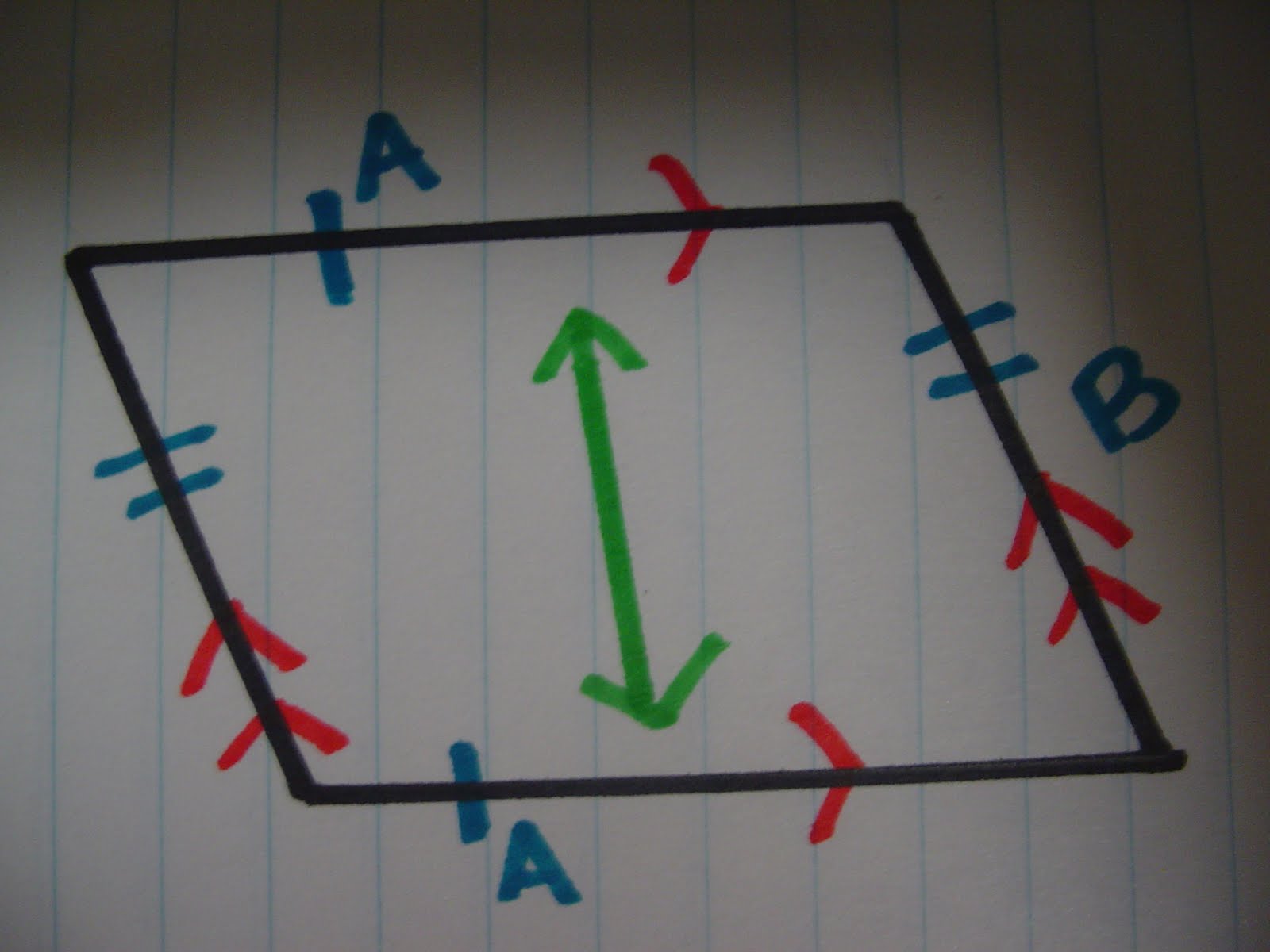
12.Question: Which of the two shapes shown below has a greater area? Explain your answer.
Answer: Shape A because the line is straighter or its more perpendicular to the base.
13.Question: The spring thaw has caused a rectangular section of the schoolyard to flood. A
parallelogram-shaped wooden walkway is being placed over it as shown. The area of the walkway is 22 m2. How wide will the base of the walkway be in meters?
Answer: 2 m. How did I got it? is by dividing 22 m to 11 m which is equal to 2 m.
Image:

http://www.mathgoodies.com/lessons/vol1/area_parallelogram.html I hope this link would help you practice more!
*SORRY I DON'T HAVE ANY VIDEO* :(